
Riga Continues Its Rise in the IMD Smart City Index






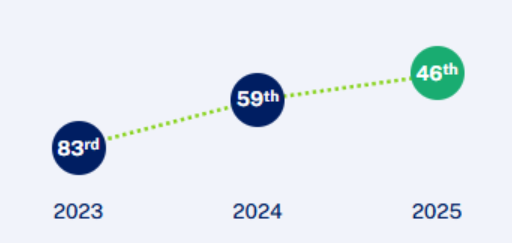
In 2025, Riga climbed 13 positions in the international IMD Smart City Index, reaching 46th place. Over two years, the city has risen a total of 37 positions, reflecting steadily growing public trust in the municipality’s progress toward a modern, inclusive, and sustainable city. In the latest ranking, Riga outperformed several major European capitals, including Barcelona, Athens, Rome, and Brussels.
The IMD Smart City Index, developed by the World Competitiveness Center, evaluates cities based on both hard data (infrastructure and technological development) and residents’ perceptions of urban life – including public services, mobility, education, healthcare, and governance.
Riga’s performance in the Index reflects not only the municipality’s strategic efforts but also citizens’ positive assessments of digital services and infrastructure. According to the survey underpinning the ranking, Riga’s residents particularly value online access to public transport information, the convenience of buying cultural event tickets online, and the benefits of public Wi-Fi in improving service accessibility. Moreover, over half of respondents stated that online information has increased their trust in public decision-making. At the same time, citizens identified key areas needing further improvement – particularly housing affordability, transparency in governance, and healthcare quality.
Detailed results on Riga’s performance are available here: IMD_Smart_City_2025_Report.pdf
Smart Projects Driving Transformation
Riga is implementing a wide range of smart city development projects across domains such as mobility, digital infrastructure, sustainable energy, climate resilience, data solutions, artificial intelligence, and social innovation. Nearly 30 projects are currently in progress. Full details can be found here: Projects – Smart Riga .
A key enabler of innovation in Riga is the Municipal Innovation Fund, established in 2022, which provides city institutions with funding to pilot or implement smart solutions aimed at improving public service delivery and internal operations. To date, over 20 pilot projects have been supported in fields such as traffic and mobility, welfare, safety, and environmental accessibility.
In mobility, the city has tested traffic flow optimization technologies such as “green wave” systems, used accident data analytics to improve road safety, and integrated weather-based traffic risk monitoring. Other initiatives include noise monitoring sensors, freight vehicle overload detection, and IoT-enabled wheelchair lift tracking to improve accessibility. In the legal domain, the Riga Orphan’s Court now uses AI tools for document transcription, translation, and workflow automation.
Beyond fostering a culture of innovation within municipal structures, the Innovation Fund also enhances institutional capacity and supports employee-led initiatives to improve services. Supporting internal innovation is a critical pillar of governance improvement in Riga, enabling structured and systematic integration of smart solutions across city operations.
Riga’s Strategic Smart City Vision
Riga’s commitment to a smart and future-ready city was further formalized on June 18, 2024, when the City Council approved the Smart City Guidelines for 2025–2030. These guidelines serve as a strategic roadmap for innovation policy and technology implementation across the municipality. They prioritize action in key areas: mobility, digital solutions and IoT, 5G connectivity, safety and resilience, smart energy, environmental technologies, health and well-being, and education.
Riga’s Smart City Vision is to become a city that is comfortable for living, favorable for business, climate-neutral, resilient to crises, and efficiently governed — using data, innovation, and smart solutions to improve quality of life, ensure sustainability, and enhance competitiveness on a global scale.
