
Effective governance, meaningful use of data and resilience in crisis situations as main focus areas in Smart Cities Conference 2025


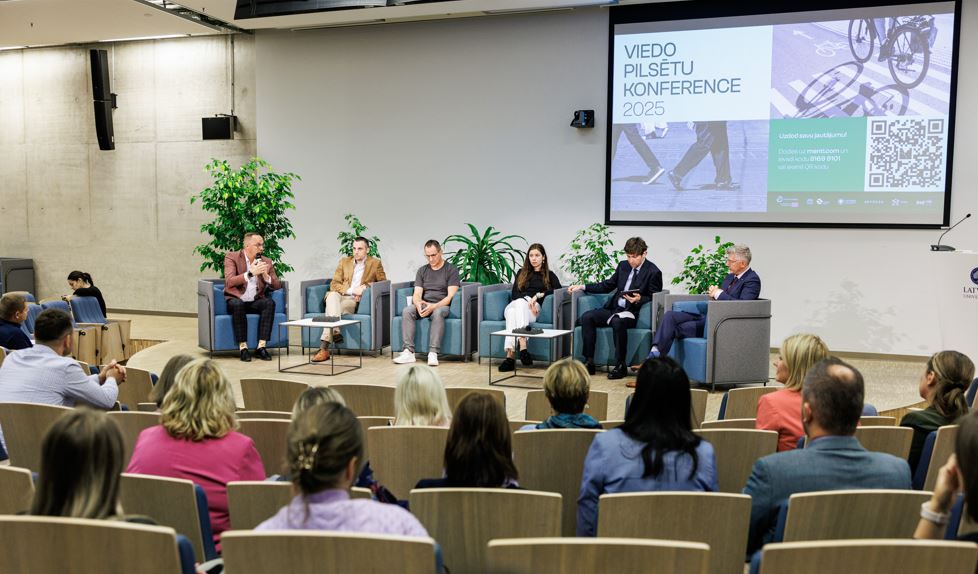
At the Smart Cities Conference 2025, which took place on September 18 at the University of Latvia’s House of Science, experts from public authorities, local governments and the private sector stressed that the main challenge is not a lack of technology, when it comes to use of data or urban security systems design but rather the people skills to use it effectively and meaningfully.
The Smart Cities Conference was held in Riga for the fourth year to focus on sustainable urban planning, mobility and public safety, highlighting the role of technology and citizen engagement in the development of future cities. The conference was organised by the RTU Science and Innovation Centre in collaboration with the University of Latvia, Riga Municipality, the open innovation movement “VEFRESH” and other partners. The event was organised by the EIT Urban Mobility Innovation Community and supported by mobile technology company “Latvijas Mobilais Telefons”.
A recording of the Smart Cities Conference can be found here: https://www.youtube.com/watch?v=4dw2ry6RRck
Experts pointed out that in order to promote the use of data in local government, it is important to define how data will be used for the benefit of local government and people. Staff need to be upskilled in working with data and their competences need to be enhanced, and the introduction of new systems means changes to existing processes, so change management and effective data governance are just as important. Often, it is the lack of these aspects that hinders the successful deployment of smart solutions in cities.
Explaining the state policy for the development of smart technologies and innovations, Gatis Ozols, Deputy State Secretary for Digital Transformation at the Ministry of Smart Administration and Regional Development, stressed that smart technologies play an important role in creating a comfortable living environment. The first ten projects, including a mobility data platform in Riga, are already underway with state support. Latvia has also been recognised at international level, with many local governments working in international project consortia with other EU countries. He pointed out that the prerequisites for the development of smart solutions and technologies are a framework for safe testing environments for smart solutions, funding, and competent professionals who can implement solutions in the field.
Anders Bengtsson, Head of the EIT UM North Hub, also stressed the need for industry and science to work hand in hand and for decisions to be based on accurate data, especially when it comes to inclusive and sustainable mobility. For mobility planning, it is important to analyse data in the long term, which will help to find the most appropriate solutions, e.g., how to organise traffic, flows, traffic signals. Telemetry, the technology that allows measurements to be taken remotely, helps in policy-making and urban planning. It promotes equity and sustainability, but requires cooperation, good governance, and a fresh look at harnessing the potential of data.
Access to data and the ability to use it is an opportunity for cities to become more sustainable, more accessible, safer. With the volume of data growing every day, local authorities need to think about collecting, storing and using data in a meaningful way for local development, to improve the quality of services, safety or people’s quality of life. One of the main conclusions of the first part of the conference was that close cooperation between local governments, science and the private sector is essential for data availability and meaningful use, while strengthening public data literacy and addressing the lack of data experts that public and local authorities face when competing with the private sector.
Kyle King, founder and director of Crisis Lab and Capacity Building International, emphasized in his presentation “Mobility and Urban Infrastructure Resilience in Crisis Situations” that great technological ambitions also mean a greater risk of experiencing a technological crisis. In the age of technology, crises can develop rapidly – for example, in the case of cyber threats or energy problems. In such situations, there is often a gap between the speed at which a technological crisis develops and the human ability to make decisions, as decisions usually require time and additional information. King pointed out that every new connection and technological solution brings new opportunities, but at the same time creates new vulnerabilities. He emphasized that cities must be prepared to act in different scenarios, with a clear protocol for how decisions are made in crisis situations. King also called for public involvement, as technological development must go hand in hand with public education, because a large part of society, especially seniors, are still not ready to use digital solutions. He also emphasized that every decision in smart city management must include a crisis management aspect, because no matter what the technology is, responsibility for decisions and actions always lies with people.
The conference included a panel discussion entitled “A Safe City – How to Protect Infrastructure, People and Information,” in which Kaspars Druvaskalns, a specialist in security policy and crisis management at the University of Latvia, and Diāna Korbe, Head of Geomatics at the City Development Department of the Riga City Council. When discussing data management, Diāna Korbe emphasized that local governments have access to a huge amount of data, but the challenge is to be able to use this data effectively. “The city must realize that high-quality services require investment—both in technology and human resources. Often, data management is not given priority, and the need for such investment must be proven,” explains Korbe. She also emphasized that it is essential to shift the focus from the quantity of data to its quality and value in decision-making, keeping the city’s residents in mind. Systemic thinking and uniform security conditions and approaches are also important.
Gints Reinsons, Deputy Head of the Crisis Management Center at the State Chancellery, shared his experience of how technology helps local governments overcome crisis situations. He pointed out that local governments have limited financial resources and cannot build infrastructure capable of overcoming all possible crises. Therefore, the ability to quickly localize damage, prevent the crisis from developing, and restore the city’s functioning as quickly as possible is crucial. Digital technologies, including remote monitoring and artificial intelligence solutions, enable the timely detection of infrastructure problems and ensure rapid action. Real-time data provides information on power outages, traffic jams, weather conditions, and mobility disruptions. He noted that if a city is prepared for extreme weather conditions, it will also be able to cope with other crisis situations.